What is Dunlop Mast Climbers and How Do They Work?
Dunlop Mast Climbers are essential lifting equipment in construction and maintenance. These devices provide safe and efficient access to high structures like towers and buildings. Understanding their functionality and design is crucial for professionals in the industry.
At their core, Dunlop Mast Climbers operate using a secure mast system. This system allows workers to ascend and descend safely on vertical surfaces. The climbers are robust, supporting significant weight while ensuring stability during operations. Users must be aware of their limitations and maintenance needs to avoid accidents.
Despite their effectiveness, not all operators are trained adequately. Improper use can lead to serious risks. It’s vital for companies to invest in proper training and regular inspections. This helps prevent potential issues with Dunlop Mast Climbers, ensuring safe and efficient working conditions.
What are Dunlop Mast Climbers? A Comprehensive Overview
Dunlop Mast Climbers are innovative equipment designed for construction and maintenance tasks. These climbers allow workers to ascend and descend vertical surfaces safely. The system typically consists of a platform supported by a mast, enabling effective movement along the structure. This is particularly useful for high-rise buildings.
These climbers are engineered to enhance productivity and safety on job sites. They feature secure harnesses and railings to prevent falls. The design allows for easy setup and dismantling, making them accessible for various projects. Workers appreciate the stability provided by the climbers during operations. However, improper use can lead to accidents, emphasizing the need for proper training.
Different environments may pose challenges when using mast climbers. Weather conditions, such as high winds, can affect stability. Additionally, ensuring the ground surface is level is crucial for safe operation. These factors highlight the importance of planning and risk assessment before utilizing the equipment. Understanding these aspects can lead to safer and more efficient work practices.
What is Dunlop Mast Climbers and How Do They Work?
| Feature |
Description |
| Definition |
Mast climbers are specialized lifting platforms used for construction and maintenance work on buildings. |
| Functionality |
They enable workers to safely access high areas and perform tasks such as painting, cleaning, or installation. |
| Components |
Includes a platform, a mast for vertical support, and a hoisting system for raising and lowering the platform. |
| Safety Features |
Equipped with guardrails, emergency stop buttons, and load sensors to ensure worker safety. |
| Applications |
Used in construction, facade maintenance, window washing, and building inspections. |
| Advantages |
Offers increased safety, efficiency, and the ability to reach difficult areas compared to ladders or scaffolding. |
| Operation |
Operated using electric or hydraulic systems to control the lift height and platform positioning. |
Key Components of Dunlop Mast Climbers: Structure and Functionality
Dunlop mast climbers are essential tools in construction and maintenance. They provide efficient access to heights, facilitating workflows on tall structures. Understanding their components is crucial for maximizing functionality.
The key components of Dunlop mast climbers include the mast itself, platforms, and drive systems. The mast acts as a vertical support framework. It stabilizes the platforms, allowing workers to carry out tasks at various elevations. Platforms are typically constructed from lightweight materials. They provide the working space needed for laborers, reducing fatigue during lengthy operations.
Drive systems are equally critical. They enable the smooth vertical movement of platforms. These systems often incorporate advanced motor technology, ensuring safety and reliability. According to industry reports, improperly maintained systems can lead to a 30% increase in accident rates. Regular inspections and maintenance are vital. Understanding these components and their functionality can enhance productivity while ensuring worker safety. This awareness can prevent costly downtime and improve overall project timelines.
How Dunlop Mast Climbers Ensure Safety in Construction Projects
Dunlop Mast Climbers are essential tools in modern construction projects. They provide vertical access for workers and materials, enhancing productivity. Safety is a primary concern in construction. According to the U.S. Occupational Safety and Health Administration (OSHA), falls are the leading cause of fatalities in the sector, accounting for 33% of all construction deaths. These statistics highlight the urgency of effective safety measures.
The design of Dunlop Mast Climbers includes advanced safety features. They offer stability and support while elevating personnel. Each climber is equipped with safety harness points and redundancies. These features minimize fall risks. Moreover, regular inspections are mandated for maintaining safety standards. A report from the National Institute for Occupational Safety and Health (NIOSH) emphasizes the importance of worker training in using equipment properly.
Despite their advantages, challenges remain. Weather conditions can affect the climber's operation. Workers may feel uneasy at heights, impacting their performance. Additionally, improper use can lead to accidents. Construction teams must prioritize training and continuous safety assessment to mitigate these issues. Investing in safety can reduce costs associated with delays and accidents. Every worker deserves a secure working environment.
Operational Mechanism of Dunlop Mast Climbers: Step-by-Step Analysis
Dunlop mast climbers are innovative lifting systems designed for vertical access. They offer a safer and more efficient way to work at heights. Understanding their operational mechanism is crucial for effective use. Operators should be trained and knowledgeable about these systems for optimum safety.
The operation begins with the assembly of the mast towers. These towers provide support and stability during the lifting process. Next, the platform is securely attached to the mast. The climbers are powered by electric hoists, allowing smooth ascent and descent. Monitoring the load capacity is essential. It prevents equipment failure and ensures worker safety.
Regular maintenance is a necessity. Inspecting the mast components may reveal wear and tear that might go unnoticed. This can lead to potential risks during operation. Operators should always encourage team communication to address any concerns. Elevating safety awareness can help to prevent accidents. The mechanics behind Dunlop mast climbers are robust, yet human oversight is a crucial factor in their effective operation.
Operational Mechanism of Dunlop Mast Climbers
This chart illustrates the operational metrics of Dunlop Mast Climbers, highlighting their load capacity, height reach, speed, power consumption, and operating cost. These metrics are essential for understanding the efficiency and application of mast climbers in various construction projects.
Industry Applications of Dunlop Mast Climbers: Case Studies and Data
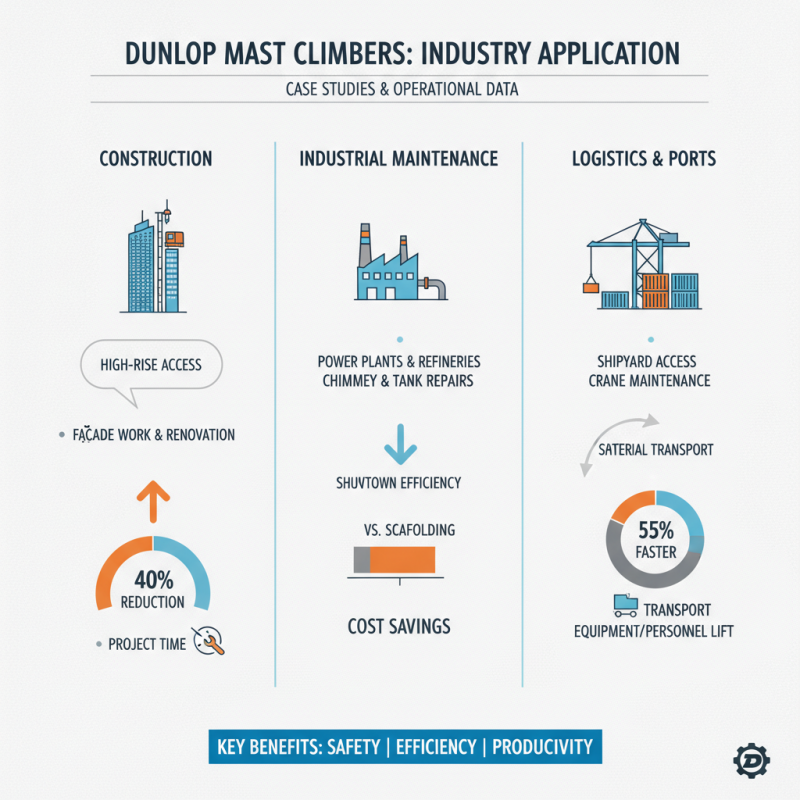
Dunlop mast climbers have found applications across various industries, showcasing their effectiveness in improving operational efficiency. In construction, these machines are invaluable for accessing high elevations. Safety involves a balance between height and stability. Case studies reveal that incorporating mast climbers reduces the time workers spend transporting materials.
In the maintenance of tall buildings, these climbers significantly enhance productivity. For instance, a recent project highlighted a reduction in labor hours by 30% compared to traditional scaffolding. However, this technology isn't foolproof. Ensuring proper setup and safety measures is crucial. Users must remain aware of the potential risks involved.
In industrial settings, mast climbers support workers in tasks ranging from inspection to repair. A notable case showed increased output during routine assessments of high structures. While effective, reliance on this machinery necessitates ongoing training. Regular maintenance checks are essential to ensure reliability. These aspects stress the importance of continuous learning and reflection in optimizing their use.